
How Aid is Disbursed

AWARDS & DISBURSEMENTS

Your financial aid will be sent to your student account on your disbursement date.

  • Fall & Spring: Two payments – one in fall, one in spring.
  • One Semester Only: First payment 30 days after classes start, second payment midway through the semester.

For exact dates, call Financial Aid at 316-677-9400.

Maybe! First, your financial aid pays for your tuition and fees.

  • If aid is less than your bill, you pay the rest.
  • If aid is more than your bill, you get a credit balance.

The extra money will be mailed to you within 14 days.

Example 1: Your total charges are $3,000, and your total financial aid award is $2,000 — you owe $1,000.

Example 2: Your total charges are $3,000, and your total financial aid award is $5,000 — you have a credit balance of $2,000, and this amount will be refunded to you.

Will my financial aid be canceled if I don’t enroll? Does it expire?
No, your aid won’t be canceled automatically. If you don’t plan to use it, you must fill out a Request for FA Cancellation form. Contact the Financial Aid Office for help.

No, your financial aid will not automatically be canceled or expired. You will need to contact the financial aid office and complete the form ‘Request for FA Cancellation’.

Yes! You must accept or decline your aid at least two business days before the semester ends.

You got a revised award because your enrollment or FAFSA information changed, you requested a change, or you received additional aid.

You’ll receive an email from the WSU Tech Financial Aid Office at both your school and personal email. This email will include a link to your MyWSUTech portal, where you can check your award details.

To view your financial aid:

  1. Log in to your MyWSUTech portal.
  2. Go to the “Financial Aid” dropdown menu.
  3. Select “Financial Aid Award” and click on the “Award Offer” tab.
  4. Scroll down to see your financial aid eligibility.

Financial aid is sent to WSU Tech 30 days after classes start and is applied to your tuition, fees, and bookstore charges.

Important things to know:

  • Pell Grants are reduced if you take less than 12 credit hours.
  • Student loans won’t be paid if you take less than 6 credit hours.
  • Dropping, withdrawing, or not attending class may reduce or cancel your aid.

If you take out a student loan, you have 14 days to cancel it. If your aid is more than your bill, the extra money will be refunded within 14 days.

  1. Check Your Bill – Log in to your MyWSUTech portal, go to the “Pay My Bill” dropdown, and select “View and Pay My Bill” to see your total charges.
  2. Review Your Financial Aid – In your MyWSUTech portal, go to the “Financial Aid” dropdown, select “Financial Aid Award,” and click on the “Award Offer” tab. Scroll down to see your total financial aid.
  3. Compare the Amounts – If your total financial aid is equal to or more than your total charges, your aid will fully cover your costs. If not, you may need to make other arrangements to pay the remaining balance.

SATISFACTORY ACADEMIC PROGRESS (SAP)

The U.S. Department of Education requires colleges to set standards for students who receive federal financial aid. To keep your aid, you must be enrolled in a program of study and be making progress toward finishing it. If you do not meet and maintain these standards, you could lose your federal and state grants, scholarships, and loans.

To meet Satisfactory Academic Progress (SAP) and continue receiving financial aid, you must:

  1. GPA – Maintain at least a 2.0 GPA
  2. Pace in Percentage of Attempted Credits Earned – Successfully complete at least 67% of overall attempted credit hours
  3. Time Limit for Finishing your Degree – Complete your degree within the maximum allowed time, which is no more than 150% of your program’s length

When you are Ready, submit your SAP Appeal Here: my.wsutech.edu/public/dashboard. Log in, then click the Financial Aid tab on your dashboard. After that, click Check Financial Aid Status.

Understanding SAP Status

Warning – This happens the first time you fall below the SAP standards. You are still eligible for financial aid, but you have one semester to improve. If you withdraw during this time, your status changes to suspension the following semester.

Suspension – If you don’t improve during the warning semester, you are ineligible for financial aid the following semester. You will remain on suspension until you meet SAP standards, or your appeal is approved. Your SAP status is reviewed again at the end of each semester.

Academic Plan – If your SAP appeal is approved, you may be asked to complete an Academic Plan with your advisor. The plan will outline specific requirements you need to meet each semester. If the completed Academic Plan is not submitted, it will stop your financial aid from paying out.

Steps to Take if Your Financial Aid is Suspended

If you are on suspension, you may file an appeal before the posted deadline.

If you are suspended for GPA or Completion Rate, your SAP Appeal must include:

  1. SAP Appeal Form.
  2. A typed statement from the student (see the “Guide to a Successful SAP Appeal – Student’s Statement” for help).
  3. Supporting documentation for each semester you did not meet SAP standards. This may include providing supporting documentation for multiple semesters. Contact Financial Aid for details.

If you are suspended for Exceeding Maximum Credits, your SAP Appeal must include:

  1. SAP Appeal Form.
  2. A typed statement from the student explaining why you exceeded the maximum credit limit (examples: changing majors, transfer credits, retaking classes).
  3. A printout of your new program from Degree Works.
  4. A statement from your advisor confirming you are on track to graduate from your new program with your new graduation date.
  5. NOTE: You may be asked to submit additional documents not listed here as your suspension may be for a combination of reasons. Contact Financial Aid for details.

If you are suspended for a combination of GPA, Completion Rate, and/or Exceeding Maximum Credits, your SAP Appeal must include:

  1. Information from the two sections above, combined. Contact Financial Aid for details.

Guide to a Successful SAP Appeal – Student’s Statement

Once you have confirmed with Financial Aid that your aid has been suspended, you can file an appeal before the posted deadline. The goal is to explain what happened, what has changed, and how you plan to do better moving forward.

  1. Explain What Happened
  • Be honest about why you didn’t meet the SAP requirements.
  • Share the main issue (examples: health problems, family emergencies, or trouble keeping up with classes).
  1. Explain What has Changed
  • Talk about what has changed, that will help you succeed and stay on track.
  • If you’ve appealed before, explain what you’re doing differently this time.
  1. Admit the Problem
  • Take responsibility and acknowledge why you didn’t meet SAP requirements, even if it was outside of your control. Perhaps you need help with time management or study skills.
  • NOTE: Lack of awareness of withdrawal policies, requirements for satisfactory academic progress, unpreparedness for college coursework, and incarceration will not be accepted as reasons for the purpose of an appeal and will automatically be denied.
  1. Explain How you Will Improve
  • Explain how you plan to seek support or use available resources to help you succeed.
  • Show the steps you’re taking now, such as tutoring, counseling, or following an academic plan.
  1. Provide Supporting Documentation
  • For each semester you did not meet SAP standards, you must submit supporting documentation. This may include providing supporting documentation for multiple semesters. Contact Financial Aid for details.
  • Examples include a doctor’s statement, copy of hospital/urgent care/physician’s bill, obituary, funeral notice or death certificate.

Valid Reasons for an Appeal May Include

  • Medical emergencies
  • Severe health issues
  • Severe personal or family problems
  • Financial or personal catastrophe

Return for a second degree or certificate

Example of a Valid Student Statement:
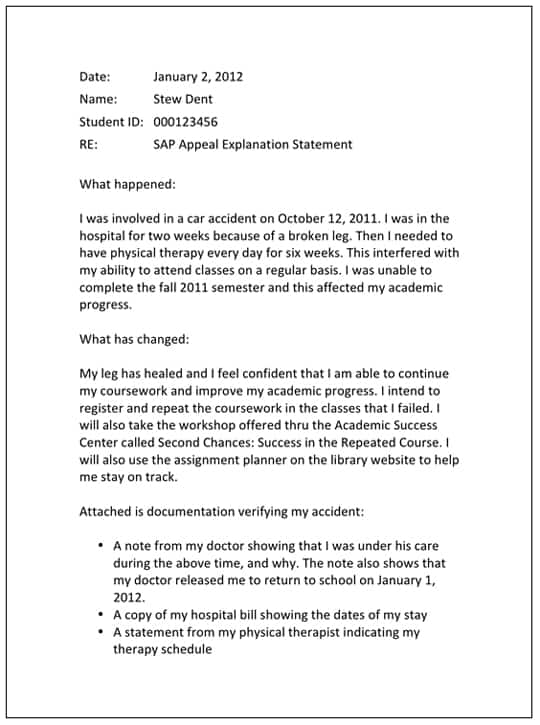
Satisfactory Academic Appeal Student Statement Example

HOW DROPPING COURSES MIGHT AFFECT YOUR AID

Thinking About Dropping or Withdrawing from a Class? Here’s what you need to know before making changes.

  • Talk First
    • Meet with the financial aid office and your advisor before you decide. Dropping or withdrawing can change your financial aid.
  • Official Drop/Withdrawal Process and Refunds
    • You have to officially drop a class through the school’s process. Not attending class will not count as an official drop/withdraw.  If you drop by a certain deadline, you may get part of your tuition back.
    • See Drop/Withdrawal Refund Policy toggle
  • Enrollment Status
    • Financial aid depends on how many classes you’re taking. Dropping/withdrawing classes could change your enrollment status, which might lower or cancel your aid. Please contact the financial aid office for more information.
  • Grades & Progress (Satisfactory Academic Progress -SAP)
    • You need to keep your GPA up, pass and complete enough classes. If you don’t, your aid could be suspended.
    • See Satisfactory Academic Progress section
  • Returning Aid (Return of Title IV Funds)
    • If you leave before finishing 60% of the semester, the school may need to return part of your aid. That could mean you owe money back to the school or the Department of Education.
    • See Return of Title IV Funds Policy toggle
  • Exit Counseling for Student Loan Borrowers
    • If you drop below half-time or withdraw, your loan repayment may start sooner. You will need to complete Loan Exit Counseling to understand your repayment plan.
    • Visit Loan Exit Counseling page

Dropping Courses

1. Get Help and Advice.

Before a student drops one or more courses, the student must speak with an Academic Advisor and with a Financial Aid Specialist. They can advise how dropping courses may affect a student, including how dropping courses will affect financial aid obligations and eligibilities.

2. Failure to Attend.

Failure to attend class does not constitute a withdrawal or a drop. To officially drop a course, the appropriate withdrawal process must be followed. Failure to withdraw from courses properly may result in money owed to the federal government and/or WSU Tech.

3. Dropping courses can be done electronically on myWSU Tech or by being submitted in writing.

Students can complete a drop by logging into a myWSU Tech account, clicking on “drop/add courses,” and then following the on screen directions.

If a student is unable to drop courses electronically, a written drop notice is required.

Students can complete an online form at www.wsutech.edu/student-drop-and-withdrawal-request. Or if preferred, a written drop notice may be provided to the appropriate Academic Advisor.

  • Get a copy of the form at the Reception Desk, complete it and leave it at the Reception Desk, or
  • Fax it to 316.677.9555, or
  • Scan it and email it to admissions@wsutech.edu, or
    • Mail it to:
      Academic Advisor/Drop Notice
      WSU Tech
      4004 N. Webb Road
      Wichita, KS 67226
  • Students can also send a letter that contains a printed name, signature, the date, address, telephone number, student ID number, and a list of the courses for which the drop is requested.
  • If the form is sent electronically, it is the student’s responsibility to follow up with the appropriate Academic Advisor to make sure that the form was received.

4. Effective Date of Written Drop Notices.

The effective date of a written drop notice is the date the form is received by the College. If the form is being mailed, be sure to allow for enough time for mail delivery since the effective date is the date the notice is received.

5. Transcripts and Drop Notices.

  • For 8 week and 16 week courses, the academic calendar shows the last day to withdraw with a “W” on a student’s transcript. The written drop notice must be received by this date for the course to appear as a “W” (Withdrawn) on a student’s transcript.
  • To receive a “W” (Withdrawn) on a transcript for all other courses (those not equal to 8 weeks or 16 weeks), the written drop notice must be received after the date that equals 25% of class meetings and before the date that equals the first 75% of class meetings.
  • Withdraw notices will not be accepted after the applicable date each semester. A grade of “W” will not be assigned; rather the earned grade to date will be entered on the transcript.
  • Questions about the dates for a course should be directed to the appropriate Academic Advisor or the Office of the Registrar.
  • Note that Transcripts are released after an account has a zero balance.

Tuition Refunds

  1. To receive a tuition refund, or an adjustment, students must drop course(s) by the deadlines shown below. When courses are dropped by the deadlines shown below, any refunds or adjustments will be automatically computed by the College.
  2. For 8-week or longer:
    • Drops received from the 1st day of class through the 7th calendar day: 80% refund for tuition, 100% refund for fees.
    • After the 7th calendar day: There are no refunds.
    • Students who did not drop and who failed to attend class during the first 7 calendar days are administratively dropped as of the 7th calendar day.
  1. For 3-week to less than 8-week Courses:
    • Drops received from the 1st day of class through the 5th calendar day: 80% refund for tuition, 100% refund for fees.
    • After the 5th calendar day: There are no refunds.
    • Students who did not drop and who failed to attend class during the first 5 calendar days are administratively dropped as of the 5th calendar day.
  1. For Courses less than 3 weeks:
    • Drops received on the 1st day of class: 80% refund for tuition, 100% for fees.
    • After the 1st day of class: There are no refunds.
    • Students who did not drop and who failed to attend the first day of class are administratively dropped as of the 1st day of class.
  1. Any refunds owed to students will be used to offset any financial obligations a student may have at WSU TECH. If financial aid paid all or part of a student’s tuition, it is often necessary for any refund to be sent back to the financial aid source.
  2. Refunds can be processed only after any required adjustments to financial aid are completed. Be sure to talk with a Financial Aid Specialist for information about the rules for financial aid adjustments.
  3. No refunds or adjustments will be made after the dates shown above, except in rare cases. Examples of rare cases may include death of an immediate family member, the student’s own serious injury or illness, serious injury or illness of someone that was dependent upon the student for support and care, and military deployment. Supporting documentation from a healthcare provider, funeral home, military supervisor, or another authoritative source is required for the committee to review the appeal. Incarceration is not considered a legitimate basis for an appeal and any such claims will be rejected.

A committee will review the student’s appeal and provide a recommendation to the Vice President of Student Success, who will approve or reject the committee’s recommendation. The committee will be comprised of the Director, Enrollment Management (Chair); Associate Director, Financial Aid; Director, Business Office; and the Registrar. To request a rare-case exception, students must complete a Tuition Refund Appeal Form. This form is available online at https://wsutech.edu/wp-content/uploads/Forms/Tuition-Refund-Appeal.pdf or at the reception desk at NCAT or Southside campuses. The following deadlines to submit a refund appeal will be enforced.

  • For courses dropped in the fall semester, the Appeal Form must be received by April 1st of the next calendar year.
  • For courses dropped in the spring semester, the Appeal Form must be received by September 1st of the same calendar year.
  • For courses dropped in the summer term, the Appeal Form must be received by November 1st of the same calendar year.

Claims related to academic issues, quality of instruction, or other educational factors are not eligible for the Tuition Refund Appeal process.

Professional Pilot Flight Fee Refunds

Students who drop courses in the professional pilot program may be refunded unused flight hour fees less a 10% non-refundable administrative fee.

Drop Actions by WSU Tech

There are no refunds for drops resulting from actions of WSU Tech, such as administrative actions, suspensions, or expulsions.

Administrative Drops due to Unmet Financial Obligations

  1. If students do not drop, do not pay, and do not make arrangements for payment by the due date announced each term by WSU Tech, WSU Tech may drop that student from the course(s) in which he/she is enrolled.
  1. If a student is not going to pay and not going to make arrangements for payment, it is to that student’s financial advantage to submit a written drop notice before the first day of the course.
  1. Arrangements for payment typically can include any one of the following methods:
    • Completion of the financial aid application,
    • Receipt by WSU Tech of necessary documents for third party payment on a student’s behalf, or
    • Completion of a payment plan agreement made by a student with the Business Office.

Repayment of Title IV Funds

For all students, if the student has received funding from student financial assistance (Stafford loans, PLUS loans, Pell Grants or ACG Grants) and withdraws during a period of enrollment or payment period, the amount that has been earned up to that point is determined on a pro rata
basis. See Financial Aid section or contact the Financial Aid office for further information. Any amounts that are unearned are added back to the student’s account as a reduction in the amount of financial aid that has been previously posted. This calculation is independent of the calculations used to determine tuition and fee refunds as described in the refund policy above. After both calculations have been performed, any resultant amount owed to the college is due immediately.

Credit Balance Refunds

Students who have a credit balance on account after payment of current enrollment charges with Title IV funds (Federal Pell grants, student loans, etc.) receive refund checks automatically within 14 days. These refund checks are mailed directly to the student using the local mailing address reported by the student to the Registrar’s office. Refund checks for credit balances created by payment with PLUS loans are issued to the parent. Financial aid for the applicable enrollment period is not credited to a student’s account until enrollment has been finalized and all associated charges have been posted. Credit balances are not refunded until all current charges have been paid in full. Students who wish to retain the credit balance in their account to cover anticipated additional educational expenses may arrange to do so by written request. Forms are available in the Financial Aid and Bursars offices. In the event that a manual check is approved and issued from a student’s account, a processing fee of $25 is charged.

Federal regulations require each college to have a written policy for the return of federal aid received by students who withdraw during a term for which payment has been received. This policy applies only if a student completely terminates enrollment from every course, cancels registration, withdraws, fails to complete the period for which they enrolled, is dismissed or stops attending classes before completing 60 percent of more of the enrollment period.

Students who plan to withdraw from WSU Tech should contact an advisor or instructor at the campus they attend or Student Services to complete the appropriate paperwork. If students have received a Pell grant, student loan or scholarship, they should also contact the financial aid office.

The Return to Title IV calculation is based on the period of enrollment completed per the college’s Academic Calendar. The percentage of unearned aid is computed by dividing the total number of calendar days in the term into the number of calendar days completed as of the student’s last date of attendance. The percentage of Title IV assistance to which the student is entitled (has “earned”) is equal to the percentage of the term completed, up to 60 percent. If the withdrawal occurs after 60 percent of the term is completed, the student has earned all federal aid. The FAO complies with final regulations with the Department of Education, for all programs offered in modules, a student is a withdrawal for Title IV purposes if the student ceases attendance at any point prior to completing the payment period or period of enrollment, unless the school obtains written confirmation from the student at the time of the withdrawal that he or she will attend a module that begins later in the same payment period or period of enrollment.

The amount of Title IV aid that must be returned is based on the percentage of unearned aid. The percentage of unearned aid is computed by subtracting the amount of unearned aid from 100 percent. The college is required to return the lesser amount—either the unearned aid percentage is applied to institution charges or the unearned aid percentage as applied to the total Title IV aid received.

Students are required to return the difference between the amount of unearned aid and the amount returned by the college. Students will be billed for any amount due to the college resulting from the return of Title IV funds that had been previously used to cover college charges such as books, uniforms or materials.

If students (or parents in the case of a PLUS loan) are required to return part or all of their loan proceeds, the amount to be returned may be repaid to the government according to the loan’s original terms.

If tuition and other costs were paid with financial aid dollars, then all or a portion of the student’s refund must be returned to the student aid program(s) from which the money was awarded. A student who receives a cash disbursement to assist with living expenses and then withdraw, drops out or is expelled may be required to repay some or all of the money back to the federal financial aid program(s). Refunds are returned to the Title IV program that provided funding for the student. Any charges left unpaid by refunds returned to Title IV programs will be billed to the student. Examples of calculations may be obtained from the financial aid office.

Funds are to be returned in order of priority as follows:
1. Unsubsidized Direct Stafford loans
2. Subsidized Direct Stafford loans
3. PLUS loans
4. Federal Pell Grants
5. Other federal, state, private or institutional financial assistance
6. Student

If students earned more aid than was already disbursed, they may be entitled to receive a late or post-withdraw disbursement for the difference.

With the Higher Education Amendments of 1998, Congress passed new provisions governing what happens to students’ federal financial assistance if they withdraw from all courses before 60 percent of the semester (or enrollment period) has passed. In essence, these provisions say that students are not entitled to 100 percent of their federal Pell Grant until they have completed 60 percent of the semester (or enrollment period), which would mean about 11 weeks in a traditional 18-week semester. If the student’s enrollment period is longer or shorter, the amount of time will be different. Of course, the vast majority of students will have already received 100 percent of their grant before this time occurs. Therefore, if a student receives a Pell Grant and withdraws before 60 percent of the term has passed, he/she owes part or all of the Pell Grant back to the federal government.

Any Pell Grant money that students have to repay will be considered a federal overpayment. Students must either repay that amount in full or make satisfactory arrangements with the U. S. Department of Education to repay the amount. Students must repay, or make repayment arrangements, within 45 days of the date they are notified of the overpayment, or they will lose further eligibility for all federal aid for attendance at any college until the debt is paid in full. To make repayment arrangements, contact the U.S. Department of Education, Debt Collection Services, 1.800.621.3115.

Once the Return to Title IV calculation is complete, the Financial Aid Office will send correspondence to the student informing them of the funds required to be returned by the college and also the student’s obligations to repay any overpayments on their behalf.